Magnesium Glycinate
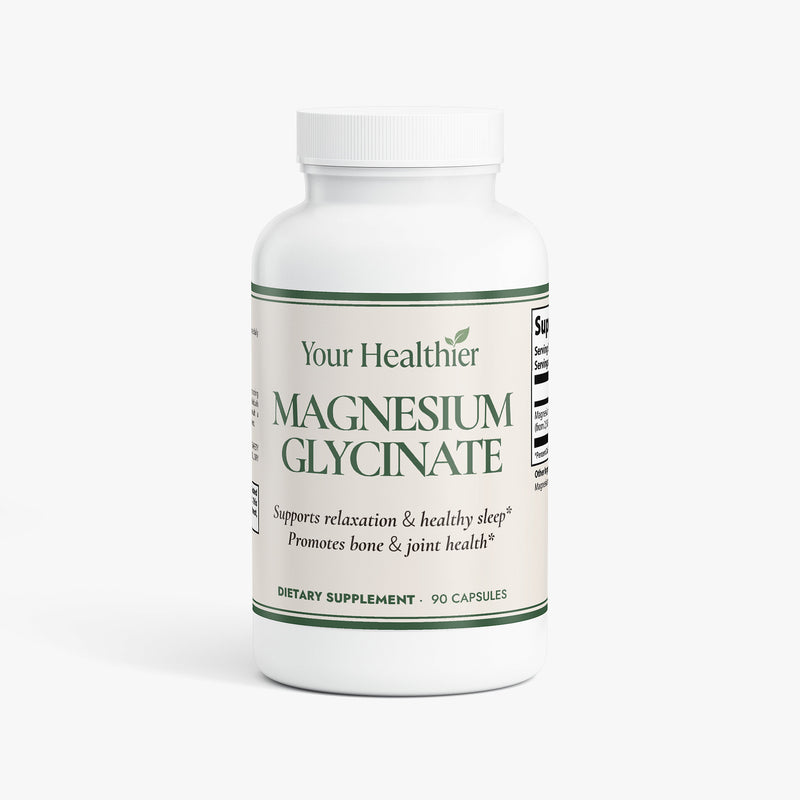
YourHealthier Magnesium Glycinate delivers 275mg elemental magnesium (65% DV) from 2,500mg magnesium glycinate per 3-capsule serving. The amino-acid-bound chelate form offers high bioavailability and gentle tolerability compared to oxide or citrate. Supports sleep, muscle relaxation, and stress recovery. Third-party tested. Made in USA. 90 capsules per bottle (30-day supply).
Frequently Asked Questions
How much magnesium glycinate should I take per day?
The standard supplemental range is 200–400 mg of elemental magnesium per day. Our product provides 400 mg per serving. Start with one serving daily and adjust based on your response. The NIH sets the tolerable upper intake level for supplemental magnesium at 350 mg for adults.
When is the best time to take magnesium glycinate?
For sleep support, take it 1–2 hours before bed. For general health, consistency matters more than timing — any time with food works. The glycine in bisglycinate may support relaxation, which is why many people prefer evening dosing.
Can magnesium glycinate cause side effects?
At recommended doses, side effects are uncommon. Bisglycinate is one of the best-tolerated magnesium forms because it bypasses the osmotic laxative effect that causes diarrhea with oxide and citrate. Mild GI discomfort can occur if taken on an empty stomach.
Is magnesium glycinate the same as magnesium bisglycinate?
Yes. Magnesium bisglycinate and magnesium glycinate refer to the same chelated compound — one magnesium ion bonded to two glycine molecules. "Bisglycinate" is the chemically precise term; "glycinate" is the common market name.
Can I take magnesium glycinate with other supplements?
Magnesium glycinate pairs well with ashwagandha (complementary stress pathways), vitamin D (magnesium is required for vitamin D metabolism), and melatonin (both support sleep through different mechanisms). Space it 2 hours from iron or zinc to avoid absorption competition.
How long does magnesium glycinate take to work?
Sleep improvements often appear within 1–2 weeks. Muscle relaxation and calm can be noticed within days. Correcting a true magnesium deficiency takes 4–6 weeks of consistent daily intake.
275mg of elemental magnesium per serving, from 2,500mg magnesium bisglycinate. You know the pattern. Midnight, wide awake, brain replaying a conversation that happened nine hours ago. Neck won't loosen up. You've gone through the melatonin phase, maybe chamomile, maybe a white noise app — none of it stuck. Meanwhile, national dietary surveys estimate that roughly half of U.S. adults don't get enough magnesium from food alone. Low magnesium may contribute to symptoms like restless sleep, muscle tension, and increased stress responsiveness in some individuals.*
Compared to other magnesium forms (oxide, citrate), magnesium bisglycinate is commonly studied and marketed for sleep and relaxation support due to its bioavailability and generally favorable GI tolerability. It's the specific form studied in the Schuster et al. 2025 RCT that reported sleep quality improvements, and the form Dr. Andrew Huberman (Stanford Neurobiology) discusses in his Sleep Toolkit at 200mg+ before bed. We put in 275mg elemental per serving — within the clinically recommended dosage range, and higher than some magnesium glycinate brands currently on the market.*
Why this magnesium glycinate
- 💤 275mg elemental magnesium — within the clinically recommended dosage range, higher than several leading magnesium glycinate brands currently on the market.
- 🧬 Pure bisglycinate — a highly bioavailable chelated form — no oxide buffering. Some products labeled "glycinate" are actually buffered with cheaper magnesium oxide. Ours is pure chelated bisglycinate.
- 🔬 Third-party lab tested — potency, heavy metals, microbials. Certificate of Analysis available on request →
- 👩⚕️ RDN review process — product claims reviewed by a licensed Registered Dietitian Nutritionist before publication
- 🏭 GMP-certified USA facility
- 🌱 Vegan. Gluten free. No proprietary blends. No fillers. Full label, nothing hidden.
Supplement Facts
| Serving Size | 3 Capsules |
| Magnesium (as Magnesium Bisglycinate) | 275 mg |
| Total Compound Weight | 2,500 mg |
Other Ingredients: Hypromellose (capsule), Magnesium Stearate, Silicon Dioxide, Rice Flour.
90 capsules · 30-day supply · Vegan · Gluten free · Non-GMO · Allergen-free
Quick note on the numbers: 2,500mg is the compound weight — how much the magnesium-plus-glycine molecule weighs. 275mg is the elemental magnesium your body actually uses. Most brands list one or the other. We list both because you shouldn't have to guess what you're paying for.
How to take
3 capsules, 30–60 minutes before bed, with food. Same protocol Dr. Andrew Huberman (Stanford Neurobiology) outlines for the bisglycinate form in his Sleep Toolkit. If you also want daytime support for stress or muscle tension, split it — 1 in the morning, 2 before bed.*
This is a gentle, highly absorbable essential mineral — no loading phase, no cycling. Glycine crosses the blood-brain barrier and supports GABA signaling, your nervous system's primary calming pathway.* Taking with food improves absorption and tolerability. Splitting large doses helps uptake. Full timing guide →
What to expect: a realistic timeline
Week 1–2
Your body starts absorbing
You may notice subtle improvements in sleep onset and muscle relaxation within the first 1–2 weeks. Magnesium glycinate is one of the most bioavailable forms, but tissue saturation takes time — especially if your levels were low to begin with. Take consistently at bedtime for best results.*
Month 1–2
Building toward steady levels
With daily use, intracellular magnesium stores gradually replenish. A small number of clinical studies — mostly in older adults with low magnesium status — have evaluated sleep outcomes over 4–8 weeks with modest but positive results. Benefits appear most pronounced in those whose magnesium levels were low to begin with; individual responses vary and may be subtle.*
Month 3–6
Sustained daily support
Longer-term supplementation supports sustained relaxation, healthy sleep patterns, and normal muscle function as part of your daily routine. If you're taking magnesium for a specific concern, periodic blood work (serum and RBC magnesium) can help confirm your levels are optimized.*
*Individual results vary. Describes general patterns observed in published research, not specific product claims. Consult your healthcare provider for personalized guidance.
Why this matters more than most people realize
Magnesium is involved in numerous physiological processes throughout the body — sleep regulation, energy production, muscle function, nerve signaling, mood, bone density, and heart rhythm. Because many adults do not consistently meet recommended magnesium intake through diet alone, low magnesium can contribute to symptoms such as muscle tension, poor sleep quality, or increased stress. Magnesium glycinate is commonly used because it is generally well tolerated and has good bioavailability compared to other forms of magnesium.*
This is the foundational dietary supplement that became the #1 most-searched supplement ingredient of 2026 for a reason: people figured out the dietary gap was real.*
What magnesium glycinate actually does
Supports sleep quality and relaxation
Abbasi et al. ran a double-blind RCT on 46 older adults with difficulty sleeping (2012, J Res Med Sci). 500mg elemental magnesium daily for 8 weeks. Sleep onset latency decreased significantly, sleep efficiency improved, and morning cortisol normalized versus placebo. A later meta-analysis pooling 3 RCTs and 151 participants (Mah & Pitre 2021, BMC Complement Med Ther) reported sleep onset dropped by an average of 17 minutes versus placebo (p=0.0006).
Then Schuster et al. (2025) published an RCT on magnesium bisglycinate specifically — the exact form in this bottle — in 155 adults with self-reported poor sleep. After 4 weeks of 250mg elemental magnesium bisglycinate daily, the supplement group reported a modest but statistically significant greater reduction in Insomnia Severity Index scores compared to placebo (p=0.049).*
Two mechanisms are at work. Magnesium modulates NMDA receptors and supports GABA signaling — your brain's calming pathway. And glycine is itself an inhibitory neurotransmitter that supports sleep onset. Yamadera et al. (2007) showed glycine before bed improved sleep quality and next-day alertness on its own. With bisglycinate you get both compounds in one molecule. That's the formulation advantage — citrate, oxide, malate, none of them carry a sleep-active second ingredient. Cited research describes the ingredients magnesium and glycine, not this specific product. Individual results vary.
Stress and the "wired but tired" spiral
Boyle et al. (2017, Nutrients) reviewed 18 human trials. The signal was consistent: magnesium supplementation supported healthy stress response, with the clearest effects in people already running low. Chronic stress may lower magnesium levels. Low magnesium levels can influence stress-response pathways, including HPA axis activity. Replenishing the mineral may help support this loop.* Full breakdown →
Muscles and cramps
Magnesium and calcium both play an important role in muscle contraction and relaxation. When magnesium is low, some people experience muscle cramps at night, daytime tightness, or slower recovery after training. Certain populations, including athletes and individuals taking diuretics, may have higher magnesium needs. Barbagallo and Dominguez covered the mechanism in Magnesium Research (2010).*
Heart, bones, energy, nerve function, mood
Magnesium is involved in numerous physiological processes throughout the body. It's a required cofactor in energy production — ATP can't be synthesized without it. It supports bone density, nerve function, mood regulation through serotonin pathways, and healthy blood pressure. A meta-analysis of 20 randomized trials reported it supports healthy systolic and diastolic function.* It's also involved in insulin sensitivity, which is why it pairs naturally with berberine for metabolic health. Less headline-grabbing than the sleep data. Arguably more important long-term.*
How magnesium glycinate works: the GABA pathway
You take
Mg Bisglycinate
Engages
GABA + NMDA
Result
Nervous system calms
💤 Sleep onset
–17 min
Faster time to fall asleep
Meta-analysis, 3 RCTs, 151 adults
🧘 Stress evidence
18 RCTs
Systematic review
Boyle 2017, Nutrients
📊 Dietary intake
~50%
U.S. adults below RDA
NHANES dietary surveys
🧬 Body-wide reach
600+
Enzymatic reactions involve Mg
Published literature
Two sleep-active compounds in one molecule
Oxide, citrate, malate — none carry a second sleep-active component. This is the structural advantage of the bisglycinate form.
Sources: PubMed-indexed research cited above. Describes studies on the ingredients magnesium and glycine, not specific product claims.
What researchers say about magnesium
Dr. Rhonda Patrick, PhD (founder of FoundMyFitness, biomedical scientist specializing in aging and nutrition) and Dr. Andrew Huberman, PhD (Professor of Neurobiology at Stanford School of Medicine, host of the Huberman Lab podcast) discuss why they recommend bisglycinate for sleep — and when L-threonate makes more sense for cognition.
The research behind this product
- Abbasi B et al. 2012 (J Res Med Sci) — Double-blind RCT, 46 elderly adults with sleep difficulties, 500mg Mg/day × 8 weeks. Sleep onset latency, efficiency, ISI scores, and cortisol all improved significantly vs placebo. (PubMed)
- Mah & Pitre 2021 (BMC Complement Med Ther) — Meta-analysis of 3 RCTs, 151 older adults. Pooled result: sleep onset latency decreased 17 min vs placebo (p=0.0006). (PubMed)
- Schuster J et al. 2025 (Nature and Science of Sleep) — Randomized, double-blind, placebo-controlled trial in 155 adults with self-reported poor sleep. 250mg elemental magnesium bisglycinate daily × 4 weeks. Modest but statistically significant reduction in Insomnia Severity Index scores vs placebo (p=0.049, Cohen's d=0.2). (PubMed)
- Boyle NB et al. 2017 (Nutrients) — Systematic review, 18 trials. Mg supported healthy stress response — strongest in low-Mg populations. (PubMed)
- Yamadera W et al. 2007 (Sleep Biol Rhythms) — Glycine before bed improved subjective sleep quality and next-day alertness. (Wiley)
- Barbagallo M & Dominguez LJ 2010 (Curr Pharm Des) — "Magnesium and aging." Review covering Mg deficiency, ATP/energy production, neuromuscular function, and age-related conditions. (PubMed)
Magnesium glycinate vs. other forms
| Form | Best for | Absorption | Stomach |
|---|---|---|---|
| Glycinate (this product) | Sleep, stress, recovery | High | Generally well tolerated |
| L-Threonate (Magtein) | Memory, cognition | High (crosses BBB) | Good |
| Citrate | Constipation | Moderate | Loose stools at higher doses |
| Malate | Energy, muscle pain | Moderate–High | Good |
| Oxide | Common in low-cost multivitamins | ~4% | Can cause loose stools |
If you want help with sleep or stress → glycinate. Memory and cognition specifically → L-threonate has the edge. Constipation → citrate, that's its primary use. Magnesium oxide is commonly used in lower-cost formulations, though it is generally considered to have lower relative bioavailability compared to some chelated forms such as magnesium glycinate. Full comparison →
How this stacks up
| Feature | YourHealthier | Typical competitors |
|---|---|---|
| Elemental Mg per serving | 275mg (3 caps) | Many leading brands deliver 120–160mg |
| Form integrity | Pure bisglycinate, no oxide buffer | Some "glycinate" products are buffered with cheaper oxide |
| Lab testing | Third-party tested, COA on request | Claimed but rarely shared |
| Health claims | RDN review process | Marketing copy, no professional oversight |
| Label | Full elemental + compound disclosure | One number — guess which one it is |
| Research citations | 5 PubMed-linked studies, named researchers | "Studies suggest…" |
275mg per serving for 30 days — more elemental magnesium per bottle than most competitors charge more for. And you can actually verify what's in it.
Who it's for
Anyone lying awake at 2am with their brain replaying something that happened nine hours ago. People carrying tension between their shoulder blades that no stretching has fixed. Women dealing with PMS-related sleep disruption or perimenopause — magnesium status may shift around hormonal changes. Athletes who cramp at 3am. Coffee drinkers, people on PPIs or diuretics or birth control — all of which can affect magnesium status.*
Some people may have difficulty meeting magnesium needs through diet alone, depending on eating patterns, health conditions, or lifestyle. Magnesium glycinate is frequently preferred due to its generally favorable gastrointestinal tolerability, making it a more comfortable choice than other types, such as magnesium citrate. If you're looking for a research-backed magnesium dietary supplement, this is what we built.
Who should NOT take this
- ❌ Kidney disease or significant kidney impairment — impaired clearance, magnesium can accumulate
- ❌ Within 2 hours of tetracycline or quinolone antibiotics — Mg chelates them, reduces absorption of both
- ❌ Within 2 hours of bisphosphonates for osteoporosis — same chelation issue
- ❌ Pregnant or breastfeeding without doctor sign-off
- ❌ Children — limited safety data outside pediatric clinical settings
Supplement suitability and dosage needs vary by individual. Consumers with kidney disease, GI disorders, those who are pregnant, or anyone taking prescription medication should seek medical guidance prior to supplementation. The drug interactions above are specific and well-documented — just separate your doses by 2+ hours. Full safety guide →
Side effects
Magnesium glycinate is commonly regarded as one of the more gentle magnesium forms due to its chelated structure. Mild loose stools can happen if you take more than your gut absorbs in one sitting, usually above 400mg elemental at once. Some people feel drowsy within an hour. For a sleep supplement, that's the product doing what it's supposed to do. If you're sensitive, start with 2 capsules the first week.*
Pairs well with
Supplement suitability and dosage needs vary by individual. Consult with a healthcare provider before combining supplements, especially if you have a medical condition or take prescription medication.
- Ashwagandha KSM-66 — A popular natural sleep + stress combination. Magnesium works on GABA and nerve function; ashwagandha may influence cortisol through the HPA axis. Different pathways, potentially complementary effects. Both before bed. Why this combo works →
- Berberine — Magnesium is a cofactor in insulin sensitivity pathways. Berberine activates AMPK. If metabolic health is your goal, these two cover different angles of the same problem. Details →
- Lion's Mane — Morning clarity, nighttime recovery. Lion's mane supports NGF and cognitive function during the day; magnesium winds the nervous system down at night. Details →
- NMN — Magnesium is required for the enzymes that convert NMN into NAD+. Without adequate Mg, NMN conversion may not be as efficient.
Go deeper
- Magnesium glycinate benefits: the complete guide
- Magnesium glycinate for sleep: what the research shows
- Magnesium sleep research: 2026 update
- Dosage guide: how much to take and when
- Best time to take magnesium glycinate
- Magnesium glycinate vs. citrate vs. oxide vs. L-threonate
- Magnesium for stress and relaxation
- Side effects and safety
- Magnesium for heart health
⚠️ *These statements have not been evaluated by the Food and Drug Administration. This product is not intended to diagnose, treat, cure, or prevent any disease. Consult your healthcare provider before starting any supplement. · Editorial Policy · Lab Results · Medical Reviewer
Supplement Facts
Usage
Backed by Peer-Reviewed Research
The clinical evidence cited in this product's structured data is fully traceable to peer-reviewed publications. Each study below is independently verifiable on PubMed.
⚕ Research summaries describe what researchers observed in specific study populations. They are not product claims and do not predict individual outcomes. These statements have not been evaluated by the FDA. This product is not intended to diagnose, treat, cure, or prevent any disease.
Cited research describes effects observed in specific study populations under specific protocols. Individual results vary. Citation of clinical research does not constitute disease claims. Editorial policy
Every batch is third-party tested by an independent laboratory against the specifications below. Figures shown are our product specifications and acceptance limits — request the lot-specific Certificate of Analysis for your batch's measured results.
Microbial Safety
Heavy Metals
Active Compounds
Better Together